The learning of this module is a new and exciting digital journey for me. Before learning, I vaguely felt that digital technology was developing rapidly and changing people’s lives. But I haven’t thought about how it will affect my work and what will happen in the future. After learning, I realised that we are involved in the digital revolution. New economic systems and new business models are born with the development of digital technology.
(Source from: allbusiness.com)
The rapid growth of digital technology, on the one hand, breaks the space restrictions, make people share and use resources much better than ever before. On the other hand, it brings a lot of issues, such as privacy risks, which also shocked the traditional business model. In such an era, we need to work hard to adapt to the trend and think about where to go.
Next, we have discussed the successful enterprises in the digital mode. After reading Claudia’s blog, I understand that enterprises shouldn’t only focus on existing profit but also analyse the trend and optimise its business model. Jacqueline’s blog showed me a typical case of how to implement marketing strategies. And I study the case of Argos in my blog, I conclude that the way for enterprises to survive is to combine its multiple channels with supporting each other optimise the consumer experience.
(Source from: Argos.co.uk)
By learning this module, I realised that although new technologies (such as AI) shocked traditional industries, people should not live in the anxiety of being replaced by AI, but better constantly update their own skills. In this way, people can make AI enable them in working, rather than replace them.
This video is to share some of my feelings and my plan.
At the end of the journey, I would like to thank Lisa and classmates who have studied this module together. Thank you!
According to Nikki (2017), Argos is one of the UK’s best multichannel retailers, which ranked top one in Retailer Week’s “Top 30 multichannel retailers” list. The success of Argos is closely related to its digital business strategy. This is not only reflected in the fact that Argos provides online shopping platforms to consumers, as Argos doesn’t believe that “Online only is the answer” (Caroline, 2018), more importantly, Argos also uses digital technology to optimise consumers’ in-store shopping experience, ingeniously combines its offline and online channels to provide consumers with more convenience, and establishes a digital rating&review system to enable consumers to get effective product information.
(Chloe, 2015)
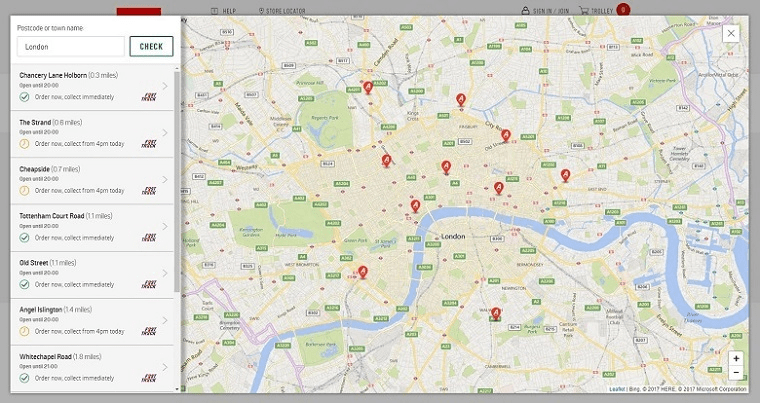
Currently, more and more retailers gradually realised the importance of digital business model, they started to build their online platform, however, this does not mean that their websites can bring consumers a more convenient shopping experience, but Argos has achieved this. According to Caroline (2018), the Argos website receives 1.2 billion clicks annually and claimed the title of the third most visited retail website in the UK (after Amazon and eBay). For a retail website, stock visibility is a highly important factor (Danny, 2015), Argos allows customers to check whether an item is available on its product page. The checking system responds very fast, providing customers a map with a list of nearby stores, customers can easily know when and where the item is available to pick up.
(Nikki, 2017)
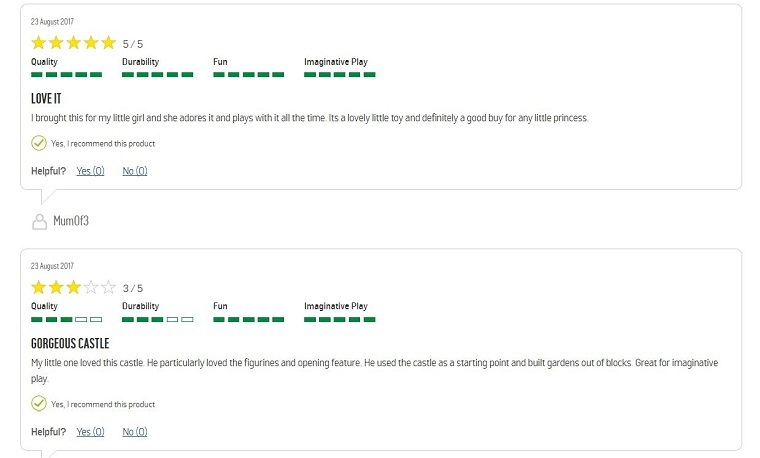
Besides, Argos offers customers a digital rating option. Consumers can rate a product out of 5 stars from different aspects. For example, they can rate a toy on “quality”, “durability” and “fun”. They can also remain their reviews towards the item in detail. By doing so, customers can learn the product information they most care about from the feedback of other customers. The feedback from consumers also makes the product information more reliable. In addition to the rating system, Argos also provides recommendations and alternatives to users to help them in making a definitive buying decision. Besides the website, Argos has also noticed the rising trend of mobile shopping. It has never stopped improving the functionality of its app to make it more user-friendly. Argos’ app covers almost all the functions of its website, additionally, geo-location technology allows the retailer to target customers with relevant and location-related messaging, and a barcode scanner lets customers instantly bring up more information about items in the catalogue. The app can not only meet the needs of people’s mobile shopping but also present the relevant information of physical stores. Through this way, Argos can better align its digital platforms with its physical channel.
(Chloe, 2016)
Apart from its online platform, Argos has also invested heavily in in-store digital technologies, notably replacing its famous laminated catalogues and pencils with tablet devices (Ben, 2016). Instead of writing down the item number on the small card and waiting in the long queue for paying at the cashier, customers currently can complete the purchase much quicker on the tablet devices. This undoubtedly helps both customers and sales assistants in saving their time. On the one hand, it brings convenience to customers, on the other hand, the salespeople can complete more transactions at the same time.
(Nikki, 2017)
One key area of online and offline alignment for Argos is its “click and collect” service. According to Chloe (2015), 72% of customers prefer to use this service when it is available. This service also leads to potential sales growth, as “click and collect” customers are reported to spend twice as much as regular shoppers (Chloe, 2016). It is obviously presented that the demand for this kind of service is evident. This service brings huge convenience to people who can’t be home to receive a delivery and do not want the hassle of chasing the courier. In this way, the customers can choose to collect their item at an Argos store near their workplace or home, and they will be notified when it is ready, then all they need to do is pick it up on their own time. In addition to “click and collect” service, Argos also offer “Fast Track” delivery, which means that customers can get same-day delivery if they make the purchase before 6pm. In comparison to competitors’ charging policies, such as Amazon’s prime monthly fee, Argos’s £3.95 one-off cost same-day delivery may be a very competitive option for customers. By offering more choice to customers for picking up items, Argos aims to providing them with fastest and most convenient shopping experience. To be specific, customers are no longer restricted to the retailer’s operating hours, they can enjoy the freedom to choose where and how they receive their items at their own convenience.
(Caroline, 2018)
In conclusion, Argos is a typical example of applying digital business model successful in its operating. It uses digital technologies in each channel to optimise consumers’ shopping experience. Besides, its online and offline platforms are well combined to support each other, which provides consumers with more convenience and freedom of choice. In return, it also brings sales growth to Argos.
Reference
Ben, Davis. (2016). What’s now & next for digital technology in retail stores?
The digital revolution has affected the development of human society, and its significance is likely to exceed the previous agricultural and industrial revolutions (Schwab, 2017). Indeed, the rise of new digital technology and artificial intelligence has impacted all traditional industries (Sabbagh et al, 2013), and is no exception to the medical community. In the digital age, not only doctors’ roles have changed, but their work efficiency has also been improved.
The application of information technology in the medical community focuses on the sharing of information resources. According to Smelcer et al (2009), the United States has been investing in the construction of electronic medical record systems (EMR) since the 1990s. Today, this system has been widely used in hospitals worldwide. Specifically, when a patient visits a hospital, the doctor can establish an electronic medical record of this patient, and systematically record his current personal medical information or check his historical data. This undoubtedly benefits the doctor’s diagnosis and treatment in many ways. On the one hand, through the use of the electronic medical record system, doctors can keep abreast of the patient’s health situation, and patients can avoid doing repeated physical examinations, which speeds up the diagnosis process, shortens the time of consultation, and makes doctors’ work more efficient. On the other hand, in addition to directly improving diagnostic efficiency, information technology has also indirectly improved the overall level of the medical community. As we all know, learning medical knowledge is a very long and difficult process, and a doctor’s diagnosis of a patient is usually based on the cases and clinical experience he has learned before. However, doctors may not be able to diagnose symptoms they have never seen, and they may misdiagnose patients because of their own experience. Currently, through the use of digital technology, a large amount of new medical cases are widely shared by doctors worldwide. Learning medical knowledge and treatment plans has become easier than before. Doctors can stop suffering from not knowing how to diagnose patients because never see a clinical case before. As a result, the doctor’s diagnostic ability is improved, the chance of misdiagnosis is reduced, and the medication and treatment plan are clarified.
Meanwhile, because of the development of information technology, the network platform is gradually used in the diagnosis process by doctors, and it is easier for people to learn medical knowledge themselves than before. With the invention of some home-use measuring instruments, doctors can guide patients to conduct physical tests at home and provide treatment plans for basic symptoms such as colds through the online platform. On the one hand, it reduces the physical contact between doctors and patients, reduces the risk of doctors being infected by bacteria, and on the other hand, makes doctors’ diagnostic work independent of time and place.
In the digital age, with the enrichment of data, the acceleration of computer processing capabilities, and the advancement of algorithms, the powerful capabilities of artificial intelligence have impacted various industries (Brynjolfsson & McAfee, 2014). So, will artificial intelligence replace the work of doctors in the future? Brynjolfsson & McAfee (2011) believed that artificial intelligence will be used as an auxiliary tool for a long time as expected, and cannot completely replace doctors. Examples of successful applications of artificial intelligence in medicine are mostly in imaging because pattern recognition that machines are good at is important in this field. According to Qiu (2018), application cases include screening for diabetic retinopathy, pathological testing of certain cancers (such as lung cancer), and identification of melanoma. However, from the current point of view, artificial intelligence systems are good at system specifications, such as completely normal or completely abnormal image modes, which can help doctors prevent omissions. But many small changes in the image cannot be judged by artificial intelligence. For example, humans can easily distinguish the puppies and blueberry cakes in the picture, but the machine cannot make it (see fig 1). Therefore, as Qiu (2018) pointed out, the most likely application form of artificial intelligence in the imaging department is as a doctor’s assistant, which performs the previous processing of the image and the secondary inspection after reading the film (such as checking whether the doctor has missed a certain nodule). In the future, there will be more and more artificial intelligence algorithms and software focused on a specific diagnosis, which is good for doctors because it can save them a lot of time. For example, it is very time-consuming for a dermatologist to examine the moles all over the body to screen for melanoma. However, with a device that specifically monitors melanoma, even patients can conduct these tests themselves. When in doubt, they just need to consult a dermatologist for a consultation.
Fig. 1. Pattern recognition
In the long run, artificial intelligence may replace some traditional doctors ‘diagnosis and prescribe treatment programs in the future, making doctors’ work more efficient. More importantly, machines can empower doctors and biological scientists to advance the medical industry. However, the application of artificial intelligence in the medical field cannot be separated from the control of doctors.
Reference:
Brynjolfsson, E., & McAfee, A. (2011). Race against the machine: How the digital revolution is accelerating innovation, driving productivity, and irreversibly transforming employment and the economy. Brynjolfsson and McAfee.
Brynjolfsson, E., & McAfee, A. (2014). The second machine age: Work, progress, and prosperity in a time of brilliant technologies. WW Norton & Company.
Sabbagh, K., Friedrich, R. O. M. A. N., El-Darwiche, B. A. H. J. A. T., Singh, M. I. L. I. N. D., & Koster, A. L. E. X. (2013). Digitization for economic growth and job creation: Regional and industry perspective. The global information technology report, 2013, 35-42.
Schwab, K. (2017). The Fourth Industrial Revolution. London: Portfolio Penguin.
Smelcer, J. B., Miller-Jacobs, H., & Kantrovich, L. (2009). Usability of electronic medical records. Journal of usability studies, 4(2), 70-84.







 Yichi's Blog