The digital revolution has affected the development of human society, and its significance is likely to exceed the previous agricultural and industrial revolutions (Schwab, 2017). Indeed, the rise of new digital technology and artificial intelligence has impacted all traditional industries (Sabbagh et al, 2013), and is no exception to the medical community. In the digital age, not only doctors’ roles have changed, but their work efficiency has also been improved.
The application of information technology in the medical community focuses on the sharing of information resources. According to Smelcer et al (2009), the United States has been investing in the construction of electronic medical record systems (EMR) since the 1990s. Today, this system has been widely used in hospitals worldwide. Specifically, when a patient visits a hospital, the doctor can establish an electronic medical record of this patient, and systematically record his current personal medical information or check his historical data. This undoubtedly benefits the doctor’s diagnosis and treatment in many ways. On the one hand, through the use of the electronic medical record system, doctors can keep abreast of the patient’s health situation, and patients can avoid doing repeated physical examinations, which speeds up the diagnosis process, shortens the time of consultation, and makes doctors’ work more efficient. On the other hand, in addition to directly improving diagnostic efficiency, information technology has also indirectly improved the overall level of the medical community. As we all know, learning medical knowledge is a very long and difficult process, and a doctor’s diagnosis of a patient is usually based on the cases and clinical experience he has learned before. However, doctors may not be able to diagnose symptoms they have never seen, and they may misdiagnose patients because of their own experience. Currently, through the use of digital technology, a large amount of new medical cases are widely shared by doctors worldwide. Learning medical knowledge and treatment plans has become easier than before. Doctors can stop suffering from not knowing how to diagnose patients because never see a clinical case before. As a result, the doctor’s diagnostic ability is improved, the chance of misdiagnosis is reduced, and the medication and treatment plan are clarified.
Meanwhile, because of the development of information technology, the network platform is gradually used in the diagnosis process by doctors, and it is easier for people to learn medical knowledge themselves than before. With the invention of some home-use measuring instruments, doctors can guide patients to conduct physical tests at home and provide treatment plans for basic symptoms such as colds through the online platform. On the one hand, it reduces the physical contact between doctors and patients, reduces the risk of doctors being infected by bacteria, and on the other hand, makes doctors’ diagnostic work independent of time and place.
In the digital age, with the enrichment of data, the acceleration of computer processing capabilities, and the advancement of algorithms, the powerful capabilities of artificial intelligence have impacted various industries (Brynjolfsson & McAfee, 2014). So, will artificial intelligence replace the work of doctors in the future? Brynjolfsson & McAfee (2011) believed that artificial intelligence will be used as an auxiliary tool for a long time as expected, and cannot completely replace doctors. Examples of successful applications of artificial intelligence in medicine are mostly in imaging because pattern recognition that machines are good at is important in this field. According to Qiu (2018), application cases include screening for diabetic retinopathy, pathological testing of certain cancers (such as lung cancer), and identification of melanoma. However, from the current point of view, artificial intelligence systems are good at system specifications, such as completely normal or completely abnormal image modes, which can help doctors prevent omissions. But many small changes in the image cannot be judged by artificial intelligence. For example, humans can easily distinguish the puppies and blueberry cakes in the picture, but the machine cannot make it (see fig 1). Therefore, as Qiu (2018) pointed out, the most likely application form of artificial intelligence in the imaging department is as a doctor’s assistant, which performs the previous processing of the image and the secondary inspection after reading the film (such as checking whether the doctor has missed a certain nodule). In the future, there will be more and more artificial intelligence algorithms and software focused on a specific diagnosis, which is good for doctors because it can save them a lot of time. For example, it is very time-consuming for a dermatologist to examine the moles all over the body to screen for melanoma. However, with a device that specifically monitors melanoma, even patients can conduct these tests themselves. When in doubt, they just need to consult a dermatologist for a consultation.
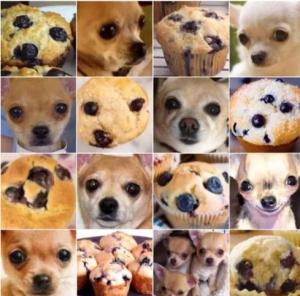
Fig. 1. Pattern recognition
In the long run, artificial intelligence may replace some traditional doctors ‘diagnosis and prescribe treatment programs in the future, making doctors’ work more efficient. More importantly, machines can empower doctors and biological scientists to advance the medical industry. However, the application of artificial intelligence in the medical field cannot be separated from the control of doctors.
Reference:
Brynjolfsson, E., & McAfee, A. (2011). Race against the machine: How the digital revolution is accelerating innovation, driving productivity, and irreversibly transforming employment and the economy. Brynjolfsson and McAfee.
Brynjolfsson, E., & McAfee, A. (2014). The second machine age: Work, progress, and prosperity in a time of brilliant technologies. WW Norton & Company.
Qiu, B. (2018). How likely is artificial intelligence to replace doctors? Retrieved from: http://m.sohu.com/a/254217784_456062?strategyid=00014.
Sabbagh, K., Friedrich, R. O. M. A. N., El-Darwiche, B. A. H. J. A. T., Singh, M. I. L. I. N. D., & Koster, A. L. E. X. (2013). Digitization for economic growth and job creation: Regional and industry perspective. The global information technology report, 2013, 35-42.
Schwab, K. (2017). The Fourth Industrial Revolution. London: Portfolio Penguin.
Smelcer, J. B., Miller-Jacobs, H., & Kantrovich, L. (2009). Usability of electronic medical records. Journal of usability studies, 4(2), 70-84.
 Yichi's Blog
Hi,YICHI. Thanks for your comment. I think the point of your article is very novel and interesting, talking about network diagnostics and electronic medical records that few people will notice and pay attention to. Indeed, for today’s medical industry, digital office has improved the efficiency of doctors’ diagnosis, especially for a country with a large population base such as China. But there are certain mistakes in artificial intelligence, which may lead to misdiagnosis and ignore some special details.
赞赞
I’m very interested in medicine and sometimes I regretted that I didn’t apply for Medical University. So, I often read medical science articles and pay attention to the latest or interesting medical development. In terms of this topic of the post, I’ve known something about it before. And after reading your post, I have more deep understanding of how digital tech influenced doctors’ works. Appropriate examples in the post help me to easy to understand how digital techs improve efficiency of doctors’ works. I really like the examples you mentioned to illustrate why AI can not replace doctors. And I totally agree with you because doctors have emotions and feelings that AI can never possess such abilities.
赞赞
Having little prior knowledge to how technology has transformed the medical industry, this article is very insightful! It is exciting to think about the possible applications of artificial intelligence in medicine and how this technology could benefit patients in the future once such innovative technology is developed. Although technology has greatly enhanced the medical profession in terms of the efficiency of diagnosis, there are potential ethical issues surrounding the privacy of data stored electronically. For example, private and potentially compromising information concerning a patient’s health issues could be obtained by hackers. How do you think that the industry can overcome such concerns and maintain their patient’s trust? This article published by Forbes highlights some of the benefits and key ethical issues involved in the storing of digital medical records. https://www.forbes.com/sites/andreamorris/2019/09/23/what-cybercriminals-steal-when-they-hack-hospitals-new-study/#9f99a794a179
赞赞